 WeCult App
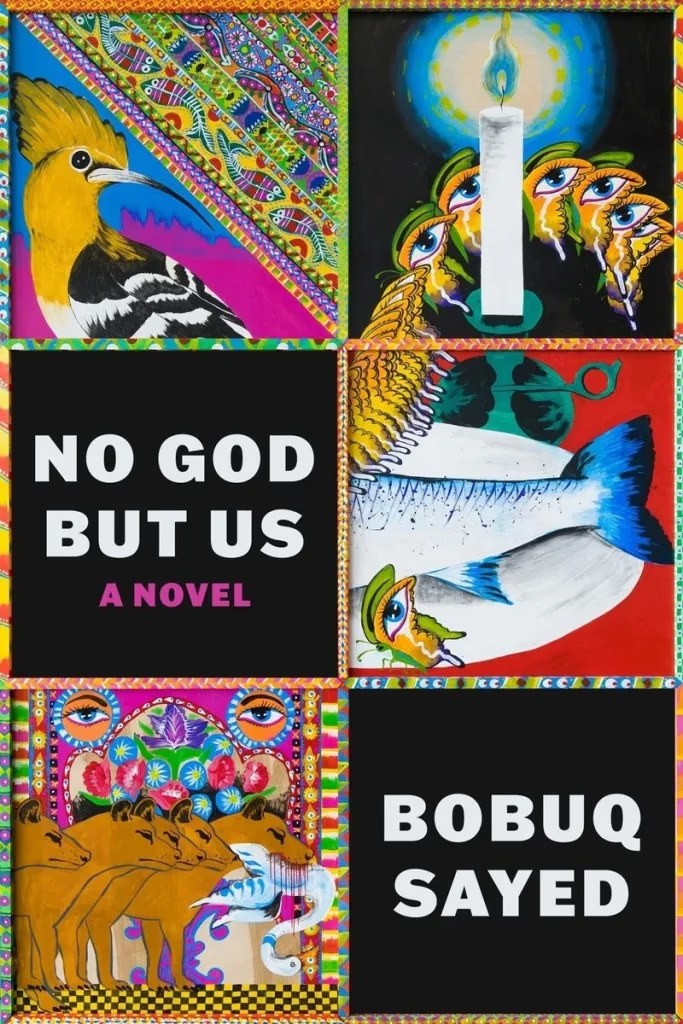
Bobuq Sayed's Debut Novel Reimagines the American Abroad Story
Bobuq Sayed's novel, No God but Us, challenges the century-old American Abroad narrative by centering queer, racialized protagonists. It explores themes of empire, desire, and contested belonging through the intertwined stories of two Afghan men in Istanbul.
Bobuq Sayed’s debut novel, No God but Us, arrives not just as a compelling story, but as a significant reimagining of a well-worn literary trope: the American Abroad novel. For over a century, this genre has followed solitary American figures journeying across the ocean, seeking personal freedom and growth unavailable in their homeland. From the pages of Langston Hughes and Ernest Hemingway to James Baldwin and Garth Greenwell, these narratives typically feature a white, heterosexual protagonist navigating a foreign, often European, city while confronting American cultural repressions.
Sayed, however, fundamentally alters this landscape. The novel's protagonist, Delbar, is an American by birth, but his identity is far more layered. As the child of Afghan refugees, his sense of belonging in the U.S. is inherently more precarious than that of his literary predecessors. He doesn't flee America to escape its inherent flaws, but rather to escape the personal fallout of being outed within his Washington D.C. diaspora community. His journey eastward brings him to Istanbul, a city increasingly hostile to dissident groups, where he encounters Mansur, an Afghan refugee who has fled Tehran.
What sets No God but Us apart is Sayed’s decision to grant Mansur his own first-person narration, a move that further subverts the traditional American Abroad framework. The narratives of these two queer, displaced Afghan men intertwine, as does their burgeoning desire for each other. Delbar's story unfolds as one of love and self-discovery, while Mansur’s narrative focuses on the quest for security and a path away from statelessness. Through their shared experiences and distinct journeys, Sayed crafts a powerful exploration of how characters displaced by imperial conflict grapple with the perceived universality of identity and confront the lingering effects of empire.
Challenging the Canon
The traditional American Abroad novel often served as a space for white American characters to find themselves, unburdened by the racial and sexual strictures of their home country. Sayed’s work directly confronts this legacy by centering characters whose very existence challenges the assumed subjectivity of the American experience. The novel asks profound questions about who gets to be an 'American Abroad' and what it truly means to be displaced, both from a homeland and from a sense of self.
A Story of Empire and Desire
No God but Us is more than just a literary experiment; it’s a deeply human story about connection forged in the crucible of shared trauma and longing. The intertwining narratives of Delbar and Mansur highlight the complexities of desire, the search for safety, and the ongoing impact of global conflicts on individual lives. Sayed’s prose is lauded for its ability to capture both the intimacy of personal relationships and the broader socio-political forces shaping their reality, offering a fresh perspective on themes of belonging and resistance.
What's Next No God but Us by Bobuq Sayed was published in 2026. Readers eager to explore this fresh perspective on identity and displacement can now find the novel wherever books are sold.
This debut novel offers a vital, contemporary re-examination of the American Abroad literary tradition, pushing its boundaries to include experiences of displacement, queerness, and the complexities of diasporic identity.




WeCult App
Track your books — all in one place
Follow releases, track progress, discover what matches your taste. Rate "Bobuq Sayed's Debut Novel Reimagines the…" on the app.
More Like This

9 Books Where Nature Gets Queer and Queer Lives Find Nature
Explore how literature is redefining our understanding of queerness not as an anomaly, but as an intrinsic, vibrant part of the natural world.

Ann Patchett's 'Whistler' Promises Luminous Reunion and Lingering Questions
Ann Patchett's highly anticipated new novel, 'Whistler,' is set to explore the intricate tapestry of memory and the enduring power of human connection. Fans can anticipate a deeply resonant story of rediscovery arriving in summer 2026.

Rebellious Literature: How Fictional Women Offer Hope in Dark Times
From the oppressive regime of Gilead to imagined matriarchal societies, literature's rebellious women are providing a vital source of hope and inspiration for readers navigating challenging realities. An exploration of these powerful narratives reveals a recurring theme of resilience and the enduring strength of the female spirit.