 WeCult App
Mind Children: Are Digital Offspring the Future of Humanity?
A provocative dinner party conversation in Silicon Valley has sparked renewed interest in a decades-old theory about humanity's future. Could consciousness uploads and digital reproduction replace biological procreation entirely?
Forget sleepless nights with a crying infant. Imagine, instead, the possibility of uploading your consciousness, creating digital descendants, and experiencing a form of reproduction unbound by biology. This isn't science fiction anymore; it's a topic gaining traction in the heart of Silicon Valley.
A recent anecdote shared by a European AI researcher highlighted this shift. During a dinner party filled with AI professionals, the host posed a thought-provoking question: "Isn’t it amazing that we are the last generation of humans who will need to think about procreating biologically? We were lucky enough to be born at a time where we can simply upload our consciousnesses instead." This statement, delivered amidst the mundane enjoyment of dinner, underscores a growing sentiment among those at the forefront of artificial intelligence development.
The Genesis of Mind Children
The idea of digital offspring, or "mind children," isn't entirely new. It finds its roots in Hans Moravec's seminal 1988 book, Mind Children: The Future of Robot and Human Intelligence. Moravec, an internationally renowned roboticist, explored a future where cultural evolution, driven by technological advancement, would eventually supersede biological evolution. His work, published by Harvard University Press, proposed that as robots and artificial intelligence become more sophisticated, humanity might transition from biological reproduction to digital creation.
At the time of its publication, Mind Children made a significant impact within specialized circles. As economist and futurist Robin Hanson noted, the book "caused a big splash in a small pond – the community" of robotics and machine-learning experts. The core concept suggests that future generations might not be born but rather created, existing as digital entities or advanced robotic forms, inheriting and evolving human consciousness in a non-biological realm. This paradigm shift implies a future where reproduction is a conscious act of design rather than a biological imperative.
What This Means for Fans of Storytelling
For avid readers and fans of speculative fiction, the concept of Mind Children opens up a universe of narrative possibilities. This isn't just about technological progress; it's about the very definition of humanity, family, and legacy. Authors have long explored themes of artificial life and consciousness, from Isaac Asimov's robots to the complex digital existences in Black Mirror. The growing discussion around digital reproduction, fueled by advancements in AI and virtual reality, brings these fictional explorations closer to potential reality.
This evolving conversation invites us to consider the profound implications for culture, society, and individual identity. If our descendants are no longer biologically tied to us, what does that mean for kinship? How do we grapple with the idea of a consciousness existing purely in a digital space? These are the questions that resonate deeply with audiences who engage with stories that push the boundaries of our understanding.
What's Next
As AI research continues its rapid acceleration, the philosophical and practical considerations raised by Hans Moravec's Mind Children will likely become even more pertinent. While the timeline for such a radical shift in reproduction remains speculative, the conversation itself signals a fascinating evolution in how we envision the future of human existence and our place within it.
Hans Moravec's prescient 1988 book, **Mind Children**, offers a fascinating lens through which to examine contemporary AI advancements and their potential impact on fundamental human experiences like reproduction and legacy.

WeCult App
Track your books — all in one place
Follow releases, track progress, discover what matches your taste. Rate "Mind Children: Are Digital Offspring the…" on the app.
More Like This
The Odyssey Tickets Hit $1,000 Amidst IMAX Demand Frenzy
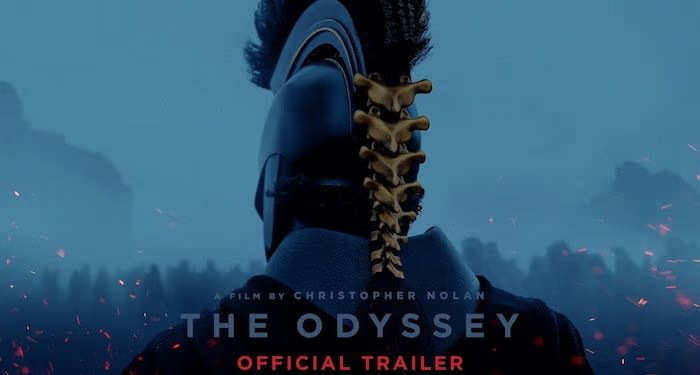
Christopher Nolan's latest cinematic event, **The Odyssey**, has ignited a ticketing firestorm, with demand for premium IMAX showings driving prices to astonishing heights on resale markets. Fans are scrambling for a piece of what's touted as a groundbreaking cinematic experience.

Forbidden Healing Ignites Passion in New Romantasy Novel
A deadly assassin and a scholar-healer must confront their forbidden attraction as a dangerous plague threatens their world. This unlikely pairing is at the heart of Brigitte Knightley's latest.
Twain Scholar Alan Gribben, Who Modified 'Huck Finn,' Dies at 84
A prominent Mark Twain scholar, Alan Gribben, has passed away at 84. Gribben was known for his controversial decision to remove racial slurs from 'The Adventures of Huckleberry Finn' in an effort to make the novel more accessible to students.